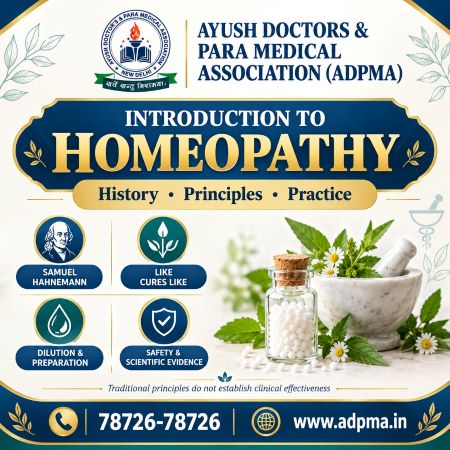
Introduction to Homeopathy: History, Principles and Practice
Published by: AYUSH Doctors & Para Medical Association (ADPMA)
Introduction
Homeopathy is a system of complementary medicine that originated in Europe in the late eighteenth century. It is based on a distinct set of traditional principles concerning the selection and preparation of remedies. Over time, homeopathy has developed an international presence and continues to be practised in several countries, including India.
Homeopathy is commonly associated with two central concepts: like cures like and the use of highly diluted preparations. Practitioners traditionally select remedies after considering a person's symptoms and individual characteristics.
However, it is important to distinguish the historical principles of homeopathy from conclusions supported by modern scientific research. High-quality evidence has not established that homeopathy is effective for treating any specific health condition beyond placebo effects. Understanding its history, principles, practice and limitations helps people make informed healthcare decisions.
1. History and Development of Homeopathy
Origin of Homeopathy
Homeopathy was developed by German physician Samuel Hahnemann in the late eighteenth century. Hahnemann questioned several medical practices common during his time and proposed an alternative approach to remedy selection and preparation.
In 1796, he published an early account of the principle that substances producing certain symptoms in healthy people might, in diluted form, be used to treat similar symptoms in sick people.
His ideas subsequently developed into a system of practice that became known as homeopathy.
Development of Homeopathic Literature
Hahnemann's major work, Organon of Medicine, presented the theoretical principles and methods of homeopathic practice. It was published in successive editions and became an influential text within the homeopathic tradition.
Another important work, Materia Medica Pura, documented observations about substances used in homeopathic remedy selection.
These publications remain historically significant for understanding how homeopathy developed. Their descriptions of remedies and treatment principles should not be confused with modern clinical evidence demonstrating therapeutic effectiveness.
Homeopathy in India
Homeopathy was introduced into India during the nineteenth century and gradually developed a substantial practitioner and educational network.
Today, homeopathy forms part of India's AYUSH framework. Its education and professional regulation are governed by the applicable statutory framework, including the National Commission for Homoeopathy (NCH).
Homeopathy's historical presence and regulatory status do not, by themselves, establish the effectiveness of individual remedies for particular diseases.
2. Fundamental Principles of Homeopathy
Homeopathy has several traditional principles that guide remedy selection and preparation.
A. The Principle of “Like Cures Like”
This principle, commonly expressed as similia similibus curentur, means “let like be treated by like.”
In homeopathic theory, a substance believed to produce certain symptoms in a healthy person may be selected in a preparation intended to address similar symptoms in a sick person.
This principle differs from the way treatments are generally evaluated in evidence-based medicine. Modern clinical research has not established that the homeopathic principle itself produces therapeutic effects beyond placebo.
B. The Principle of Dilution
Homeopathic remedies are often prepared through repeated dilution of an original substance.
Many preparations use dilution scales identified by labels such as X, C or LM. The concentration of the starting substance depends on the preparation method and the dilution scale.
At sufficiently high dilutions, a preparation may be unlikely to contain even a single molecule of the original substance, depending on the starting concentration and dilution process.
The proposed therapeutic effects of such highly diluted preparations have not been established through reliable scientific evidence.
C. Succussion and Trituration
Traditional homeopathic preparation methods may include:
- Succussion: Vigorous shaking of a liquid preparation at successive stages of dilution.
- Trituration: Grinding a substance, commonly with lactose, as part of a preparation process.
Homeopathic theory assigns significance to these methods. However, the claim that these procedures reliably create a therapeutic effect in highly diluted preparations has not been established by robust scientific evidence.
D. Individualised Remedy Selection
Homeopathic practitioners traditionally consider a person's symptoms, their characteristics and other individual details when selecting a remedy.
This may involve asking about the onset of symptoms, associated complaints, lifestyle and general health history.
A detailed consultation can provide an opportunity for patients to discuss their concerns. Nevertheless, the individualised nature of a consultation does not demonstrate that the remedy selected is effective for the condition being treated.
E. The Concept of Minimum Dose
The minimum-dose principle refers to the traditional preference for using very small quantities of a remedy.
Some homeopathic products are highly diluted, while others contain measurable quantities of their starting ingredients. Therefore, not all products marketed as homeopathic have the same composition or risk profile.
Safety depends on the actual ingredients, concentration, manufacturing quality and method of use.
3. How Is Homeopathic Practice Conducted?
A typical homeopathic consultation may involve several stages. The details vary according to the practitioner and the clinical setting.
Step 1: Patient History
The practitioner asks about the patient's symptoms, medical history, current medicines and other relevant health information.
A comprehensive history can be useful for identifying concerns that may require conventional medical assessment.
Step 2: Symptom Assessment
The practitioner records the nature, duration and pattern of the symptoms. Some practitioners also ask about sleep, appetite, daily habits and other personal characteristics as part of the traditional homeopathic assessment.
These details should not replace appropriate examination, diagnostic testing or evidence-based clinical assessment when indicated.
Step 3: Remedy Selection
Based on the consultation, the practitioner selects a remedy according to homeopathic principles.
The selection process is different from the evaluation of medicines whose efficacy and safety are established through well-designed clinical trials.
Step 4: Remedy Administration
Homeopathic products may be supplied as pellets, tablets, liquid preparations or other formulations. Their ingredients and concentrations can vary.
Patients should follow appropriate professional guidance and product instructions. They should not assume that all homeopathic products are chemically inactive or risk-free.
Step 5: Follow-Up
The practitioner may review the patient's symptoms and response at a subsequent appointment.
If symptoms persist, worsen or suggest a serious condition, appropriate medical evaluation should not be delayed while waiting for a response to a homeopathic remedy.
4. Common Types of Homeopathic Preparations
Homeopathic products are available in several forms.
A. Pellets and Globules
Small sugar-based pellets or globules are commonly used as carriers for homeopathic preparations. Their composition depends on the product and manufacturing process.
B. Tablets
Homeopathic tablets may contain lactose, sucrose or other ingredients, depending on the formulation.
C. Liquid Preparations
Liquid products may contain water, alcohol or other ingredients. The composition and concentration should be checked on the label, particularly when the product is intended for children or people who need to avoid alcohol.
D. Mother Tinctures
A mother tincture is a starting preparation used in some homeopathic manufacturing processes. It may contain measurable quantities of plant-derived or other substances and should not be assumed to be highly diluted.
Products containing active ingredients may cause side effects, toxicity or interactions with medicines.
5. Homeopathy and Modern Scientific Evidence
Scientific evaluation is important when assessing any medical treatment.
Clinical research into homeopathy has produced mixed findings across studies, and study quality has varied. However, major evidence assessments have not established reliable, reproducible benefits of homeopathy for treating specific health conditions beyond placebo effects.
Several issues are important when interpreting research:
- Study quality: Small studies and methodological limitations can make results unreliable.
- Placebo effects: Symptoms may improve because of expectations, the consultation experience, natural recovery or other factors.
- Individual studies: A positive finding in one study does not establish that a treatment is effective.
- Systematic reviews: Reviews of multiple studies help assess whether findings are consistent and reliable.
- Product composition: Remedies with measurable ingredients may have different risks from extremely diluted preparations.
The absence of established efficacy does not mean that a patient's reported experience is necessarily insincere. It means that symptom improvement alone cannot determine whether a remedy caused the improvement.
Homeopathy should not be presented as a scientifically proven treatment for diseases without reliable supporting evidence.
6. Homeopathy and Patient Safety
Patient safety must remain a priority regardless of the treatment approach.
A. Do Not Delay Necessary Medical Treatment
Homeopathy should not replace proven treatment for serious or potentially life-threatening conditions.
Conditions such as severe infections, cancer, heart disease, diabetes and other significant illnesses require appropriate medical assessment and management.
B. Understand the Ingredients
Highly diluted products may contain little or none of the original substance. However, some products contain measurable ingredients, alcohol or other substances that may cause harm.
Read the label and consult an appropriately qualified healthcare professional if the composition or safety of a product is unclear.
C. Be Cautious With Children
Children may be especially vulnerable to dehydration, rapidly progressing illness and certain toxic substances. Seek appropriate medical care for concerning symptoms rather than relying on homeopathic products alone.
D. Pregnancy and Breastfeeding
The safety of a product depends on its ingredients and formulation. Pregnant or breastfeeding individuals should seek advice from an appropriately qualified healthcare professional before using medicinal products.
E. Report Adverse Effects
If a person develops an unexpected or serious reaction after taking a homeopathic product, they should seek appropriate medical advice. Serious symptoms require prompt or emergency care.
7. Homeopathic Pharmacy and Quality Standards
The quality of a medicinal product is important for patient safety.
Manufacturing and quality-control processes may address ingredient identity, preparation methods, contamination, packaging, storage and labelling.
Consumers and healthcare professionals should check:
- Product name and ingredients.
- Manufacturer details and batch information.
- Expiry date and storage instructions.
- Applicable manufacturing and quality requirements.
- Any relevant warnings or precautions.
Regulatory compliance and manufacturing quality do not, on their own, prove that a product is clinically effective for a particular disease.
8. Homeopathy Education and Professional Regulation in India
Homeopathy education and professional practice in India are governed by the applicable statutory framework, including the National Commission for Homoeopathy (NCH).
Students considering a homeopathy qualification should verify the institution and programme through official sources and confirm that the qualification meets the applicable requirements for the intended professional role.
Important considerations include:
- Institutional and programme recognition where required by law.
- Eligibility criteria and admission requirements.
- Curriculum, practical training and clinical exposure.
- Applicable registration requirements.
- Current professional standards and permitted scope of practice.
An educational certificate does not automatically provide statutory registration, a professional licence or authority to practise independently. Such rights depend on the relevant qualification and current legal requirements.
Healthcare professionals should practise within their authorised scope, maintain accurate records, protect patient confidentiality and refer patients for appropriate medical evaluation when necessary.
9. Homeopathy and Conventional Medicine
Homeopathy and conventional medicine differ in their theoretical foundations, methods of remedy selection and approach to evaluating treatments.
Conventional medical treatments are generally assessed through established methods of scientific investigation, including clinical trials and systematic reviews. Homeopathy uses its own traditional principles, but reliable evidence has not established specific therapeutic effects beyond placebo.
Patients should make treatment decisions on the basis of the best available evidence, the nature and severity of their condition, potential risks and advice from appropriately qualified healthcare professionals.
Where a patient uses complementary products, they should inform their treating healthcare professional so that possible interactions, delays in treatment and other safety concerns can be assessed.
10. Frequently Asked Questions (FAQs)
Q1. What is homeopathy?
Homeopathy is a system of complementary medicine developed in the late eighteenth century by Samuel Hahnemann. It is traditionally based on the principles of “like cures like” and the use of diluted preparations.
Q2. Who founded homeopathy?
Homeopathy was developed by German physician Samuel Hahnemann.
Q3. What does “like cures like” mean?
It refers to the traditional homeopathic idea that a substance capable of producing certain symptoms in a healthy person may be used in a preparation intended to address similar symptoms in a sick person.
Q4. Are homeopathic remedies scientifically proven to treat diseases?
Reliable scientific evidence has not established that homeopathy is effective for treating specific health conditions beyond placebo effects. Evidence and safety should be assessed carefully rather than inferred from traditional claims or individual experiences.
Q5. Are all homeopathic products highly diluted?
No. Many products are highly diluted, but some preparations, including mother tinctures and lower-dilution products, may contain measurable quantities of their ingredients.
Q6. Can homeopathy replace prescribed medicines?
Patients should not stop or replace prescribed treatment with homeopathy without consulting their treating healthcare professional. Delaying effective care can be dangerous, particularly for serious illnesses.
Q7. How can students verify homeopathy education and professional requirements in India?
Students should consult the National Commission for Homoeopathy and other relevant official sources to confirm applicable institutional, qualification and registration requirements.
Conclusion
Homeopathy has a distinct history and a set of traditional principles that have influenced its practice in India and other countries. Understanding its origins, preparation methods and consultation practices is useful for healthcare education and public awareness.
At the same time, responsible healthcare requires clear communication about scientific evidence, product quality, safety and treatment limitations. Traditional practice and regulatory status should not be confused with proof of clinical effectiveness.
By prioritising patient safety, informed decision-making and appropriate medical evaluation, healthcare professionals can help the public make better-informed choices about complementary healthcare practices.
About AYUSH Doctors & Para Medical Association (ADPMA)
AYUSH Doctors & Para Medical Association (ADPMA) supports healthcare awareness, professional education and the responsible exchange of knowledge related to healthcare and allied fields.
Contact Details
AYUSH Doctors & Para Medical Association (ADPMA)
Aman Nagar, Behind Green Land School, Near Jalandhar Bye Pass, Ludhiana – 141008, Punjab, India
Email: adpma2001@gmail.com
Website: https://www.adpma.in