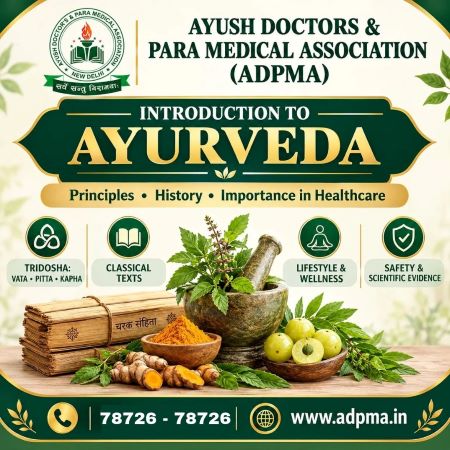
Introduction to Ayurveda: Principles, History and Importance in Healthcare
Published by: AYUSH Doctors & Para Medical Association (ADPMA)
Introduction
Ayurveda is a traditional system of healthcare that originated in the Indian subcontinent and has developed over centuries. The word Ayurveda is derived from two Sanskrit words: Ayus, meaning life, and Veda, meaning knowledge. It is commonly understood as the “knowledge of life.”
Ayurveda emphasises the relationship between lifestyle, diet, daily routines, environmental factors and overall well-being. Its traditional framework seeks to understand health in a holistic manner, considering physical, mental and behavioural aspects of life.
Today, Ayurveda remains an important part of India's traditional healthcare heritage. It is also studied and practised within the broader AYUSH framework. Understanding its historical foundations, core concepts, potential applications and limitations helps individuals make informed healthcare decisions.
1. History and Development of Ayurveda
Ayurveda has a long history associated with India's intellectual, cultural and medical traditions. Its knowledge developed through traditional teaching, clinical experience, written texts and the transmission of practices across generations.
Several classical texts have played an important role in the development of Ayurvedic theory and practice.
Charaka Samhita
The Charaka Samhita is one of the major classical texts of Ayurveda. It discusses concepts relating to health, disease, diagnosis, diet, medicinal substances and the responsibilities of the physician.
It is particularly associated with the tradition of internal medicine, known as Kaya Chikitsa.
Sushruta Samhita
The Sushruta Samhita is an important classical text associated with surgery and related medical knowledge. It describes traditional surgical procedures, anatomical concepts, instruments and methods of managing certain injuries and conditions.
Its historical importance lies in its contribution to the development of traditional Indian medical knowledge.
Ashtanga Hridaya
The Ashtanga Hridaya, attributed to Vagbhata, presents a systematic account of important Ayurvedic concepts and practices. It covers topics such as preventive health, diet, daily routines, disease management and therapeutic approaches.
These classical texts continue to influence the study of Ayurveda. Their historical significance should be understood alongside contemporary scientific research, current clinical standards and applicable healthcare regulations.
2. Fundamental Principles of Ayurveda
Ayurveda is based on a traditional conceptual framework used to understand the human body, health and disease. Some of its most widely recognised principles are described below.
A. Tridosha Theory
The Tridosha theory identifies three functional principles called Vata, Pitta and Kapha.
- Vata: Traditionally associated with movement, communication and the regulation of bodily activities.
- Pitta: Traditionally associated with transformation, digestion and metabolic processes.
- Kapha: Traditionally associated with stability, structure and lubrication.
According to Ayurvedic theory, the relative balance and disturbance of these doshas help explain an individual's health and disease.
These concepts belong to Ayurveda's traditional theoretical framework and should not be treated as direct equivalents of established biomedical mechanisms.
B. Panchamahabhuta
The Panchamahabhuta concept describes five fundamental elements:
- Prithvi (Earth): Associated with solidity and structure.
- Jala (Water): Associated with fluidity and cohesion.
- Agni (Fire): Associated with transformation.
- Vayu (Air): Associated with movement.
- Akasha (Space): Associated with space and openness.
In traditional Ayurvedic thought, these elements provide a conceptual basis for understanding substances, bodily functions and the natural environment.
C. Prakriti
Prakriti refers to an individual's constitution within the Ayurvedic framework. It is traditionally understood in relation to the relative predominance of Vata, Pitta and Kapha.
Prakriti-based assessment may influence traditional recommendations concerning diet, daily routines and other lifestyle practices.
However, Prakriti should not be confused with a validated biomedical diagnostic test, and it cannot replace appropriate medical evaluation.
D. Agni
Agni is an important Ayurvedic concept associated with digestion and transformation.
Traditional Ayurvedic approaches place considerable emphasis on digestive function, dietary habits and regular eating routines. From a modern health perspective, maintaining a balanced diet and recognising persistent digestive symptoms are important, although Agni and physiological digestion are not identical concepts.
E. Dinacharya and Ritucharya
Ayurveda places importance on daily and seasonal routines.
Dinacharya refers to traditional daily practices intended to support regularity and well-being. Ritucharya refers to seasonal adjustments in diet and lifestyle.
Examples may include maintaining regular sleep patterns, eating balanced meals, engaging in appropriate physical activity and adapting clothing or outdoor activities to weather conditions.
Specific traditional recommendations should be assessed for suitability, safety and individual circumstances.
3. Major Branches of Ayurveda
Classical Ayurveda describes eight major branches, commonly referred to as Ashtanga Ayurveda.
|
Branch |
Traditional area of focus |
|
Kaya Chikitsa |
Internal medicine |
|
Shalya Tantra |
Surgery |
|
Shalakya Tantra |
Disorders involving the eyes, ears, nose, throat and related structures |
|
Kaumarabhritya |
Child health and paediatric care |
|
Agada Tantra |
Toxicology and poisoning |
|
Bhuta Vidya |
Traditional approaches to certain mental and behavioural conditions |
|
Rasayana Tantra |
Rejuvenation and healthy ageing |
|
Vajikarana Tantra |
Reproductive health and vitality |
These branches illustrate the breadth of topics addressed in classical Ayurvedic literature. Their historical descriptions should not be interpreted as proof that every traditional intervention is effective or appropriate under modern clinical standards.
4. Common Ayurvedic Approaches and Practices
Ayurveda includes a range of traditional approaches involving diet, lifestyle, medicinal substances and specialised procedures.
A. Dietary and Lifestyle Practices
Diet and daily routines occupy an important place in Ayurvedic theory. Traditional recommendations may consider an individual's constitution, digestive patterns, habits and environmental circumstances.
General health practices such as consuming a varied diet, maintaining adequate hydration, sleeping regularly and engaging in appropriate physical activity can also support overall well-being.
Specific restrictive diets should be approached cautiously, particularly by children, older adults, pregnant individuals and people with chronic health conditions.
B. Herbal Preparations
Ayurvedic traditions include the use of plants and plant-based formulations. Commonly known examples include Tulsi, Amla, Turmeric and Ashwagandha.
The composition, concentration, quality and safety of herbal preparations can vary. Some may interact with prescription medicines, while others may cause adverse effects or contain contaminants.
Herbal products should therefore be selected carefully and used with appropriate professional guidance.
C. Panchakarma
Panchakarma is a group of specialised procedures described in Ayurveda. Traditional classifications include Vamana, Virechana, Basti, Nasya and Raktamokshana, although classifications and clinical approaches may vary.
These procedures are not equivalent to routine wellness activities. Some can carry significant risks and should not be attempted independently or without appropriate professional assessment, trained supervision and suitable facilities.
Claims that Panchakarma universally removes toxins or cures chronic diseases should not be accepted without reliable evidence.
D. Yoga and Meditation
Yoga and meditation are often discussed alongside Ayurveda in Indian wellness traditions. They may support physical activity, relaxation, flexibility and stress management when appropriately practised.
Yoga has its own philosophical and practical traditions, and it is recognised as a distinct system within the AYUSH framework.
Yoga or meditation may complement appropriate healthcare, but they should not replace necessary diagnosis or treatment.
5. Importance of Ayurveda in Healthcare
Ayurveda has cultural, educational and healthcare significance in India. Its contributions and potential applications can be considered in several areas.
A. Emphasis on Preventive Health
Ayurvedic traditions place importance on daily habits, dietary practices and seasonal routines. These themes provide opportunities for health education and discussions about sustainable lifestyle choices.
Preventive healthcare should nevertheless be guided by reliable evidence, appropriate screening recommendations and established public-health measures.
B. Holistic Health Perspectives
Ayurveda traditionally considers multiple aspects of life, including diet, sleep, activity and personal routines.
This broader perspective can encourage people to reflect on their habits and discuss lifestyle-related concerns with qualified healthcare professionals.
C. Cultural Heritage and Traditional Knowledge
Ayurveda forms an important part of India's traditional medical heritage. Its classical literature, terminology, medicinal knowledge and historical practices remain relevant to cultural and academic study.
Responsible preservation of this knowledge should include careful documentation, quality control, ethical practice and scientific evaluation where appropriate.
D. Research and Evidence Development
Research into Ayurvedic medicines and practices can examine their composition, safety, biological effects, clinical outcomes and possible interactions.
Good-quality research is necessary to distinguish traditional claims from effects demonstrated through reliable clinical evidence. Findings for one product or formulation should not automatically be generalised to all Ayurvedic preparations.
E. Integration With Healthcare Services
Ayurveda is offered within various healthcare and educational settings in India, subject to applicable institutional and regulatory arrangements.
Any collaboration between Ayurveda and other healthcare systems should prioritise patient safety, clear professional responsibilities, appropriate referrals and evidence-informed decision-making.
6. Ayurveda and Modern Scientific Research
The relationship between Ayurveda and modern science requires careful evaluation.
Some Ayurvedic ingredients have been investigated in laboratory studies and human clinical trials. However, the amount and quality of evidence vary considerably across plants, formulations, procedures and claimed uses.
When evaluating an Ayurvedic product or treatment, important questions include:
- Has the specific formulation been studied in reliable human trials?
- Are its ingredients and concentrations clearly identified?
- Have adverse effects and drug interactions been assessed?
- Are the study findings relevant to the intended patient population?
- Are the health claims supported by appropriate evidence?
- Does the proposed use comply with applicable laws and professional standards?
Laboratory findings alone do not establish that a treatment is effective in humans. Likewise, traditional use and long-standing popularity are not sufficient to establish safety for every person or condition.
A balanced approach respects traditional knowledge while applying appropriate standards of evidence and patient protection.
7. Safety Precautions When Using Ayurvedic Medicines
Although Ayurveda has a long history, its products and procedures are not automatically free from risk.
The following precautions are important.
1. Consult an Appropriately Qualified Professional
Seek professional advice before using Ayurvedic products to manage a medical condition, especially if you have an existing illness or take regular medicines.
2. Check Product Quality
Review the ingredients, manufacturer information, batch number, expiry date and other available quality details. Avoid products making unrealistic promises of guaranteed cures.
3. Be Aware of Possible Drug Interactions
Herbal preparations may interact with prescription medicines, over-the-counter medicines and other supplements. Inform your healthcare professional about all products you are using.
4. Take Special Care During Pregnancy and Breastfeeding
The safety of many herbal products and Ayurvedic formulations has not been adequately established during pregnancy or breastfeeding. Do not self-medicate during these periods.
5. Exercise Caution With Metal-Containing Preparations
Some Ayurvedic formulations may contain metals or minerals. Improperly manufactured or contaminated products can cause serious toxicity, including harm to the kidneys, liver or nervous system.
Use products only after appropriate professional assessment and verification of relevant quality and safety information.
6. Do Not Delay Necessary Medical Treatment
Persistent symptoms, severe pain, breathing difficulties, chest pain or other warning signs require appropriate medical evaluation. Ayurvedic products should not delay emergency care or replace essential prescribed treatment without clinical guidance.
8. Ayurveda Education and Professional Responsibilities in India
Ayurveda education and professional practice in India are subject to specific regulatory frameworks. The National Commission for Indian System of Medicine (NCISM) is an important statutory body associated with the regulation of education and professional standards for Indian systems of medicine, including Ayurveda.
Students and prospective practitioners should verify the recognition and status of their chosen educational institution and qualification through the relevant official sources.
Before enrolling in a course, consider:
- Whether the institution and programme have the applicable approvals or recognition required by law.
- The eligibility criteria, duration and curriculum.
- The nature of practical training and clinical exposure.
- The applicable registration and professional eligibility requirements.
- Whether the qualification permits the intended professional role under current rules.
A certificate or diploma does not automatically confer statutory registration, a professional licence or authority to practise independently. Eligibility depends on the qualification, applicable regulations and relevant professional requirements.
Healthcare professionals should also maintain confidentiality, obtain appropriate consent, document care accurately, communicate honestly and work within their authorised scope of practice.
9. Frequently Asked Questions (FAQs)
Q1. What is Ayurveda?
Ayurveda is a traditional Indian system of healthcare that considers diet, lifestyle, medicinal substances and individual characteristics within its own theoretical framework.
Q2. What are the three doshas in Ayurveda?
The three doshas are Vata, Pitta and Kapha. They are traditional Ayurvedic concepts used to describe functional principles associated with the body and its activities.
Q3. What are the major classical texts of Ayurveda?
The Charaka Samhita, Sushruta Samhita and Ashtanga Hridaya are among the best-known classical Ayurvedic texts.
Q4. Are Ayurvedic medicines always safe because they are natural?
No. Natural products can cause side effects, interact with medicines or contain harmful contaminants. Safety depends on the ingredients, preparation, quality, amount used and individual health circumstances.
Q5. Can Ayurveda replace modern medical treatment?
Ayurvedic practices should not automatically be treated as substitutes for necessary medical care. Decisions about treatment should be made with an appropriately qualified healthcare professional, taking the condition and available evidence into account.
Q6. How can students verify an Ayurveda qualification in India?
Students should check the institution, programme and qualification against the applicable requirements and official information published by the relevant regulatory authorities, including NCISM where appropriate.
Conclusion
Ayurveda represents an important part of India's traditional healthcare heritage. Its classical concepts, emphasis on lifestyle and extensive history continue to influence traditional health education and practice.
At the same time, responsible healthcare requires careful assessment of evidence, medicine quality, possible interactions and the limits of individual professional competence.
By combining respect for traditional knowledge with scientific evaluation, appropriate regulation and patient-centred care, healthcare professionals can contribute to informed public awareness and safer healthcare decisions.
About AYUSH Doctors & Para Medical Association (ADPMA)
AYUSH Doctors & Para Medical Association (ADPMA) supports healthcare awareness, professional education and the responsible exchange of knowledge related to healthcare and allied fields.
Contact Details
AYUSH Doctors & Para Medical Association (ADPMA)
Aman Nagar, Behind Green Land School, Near Jalandhar Bye Pass, Ludhiana – 141008, Punjab, India
Email: adpma2001@gmail.com
Website: https://www.adpma.in