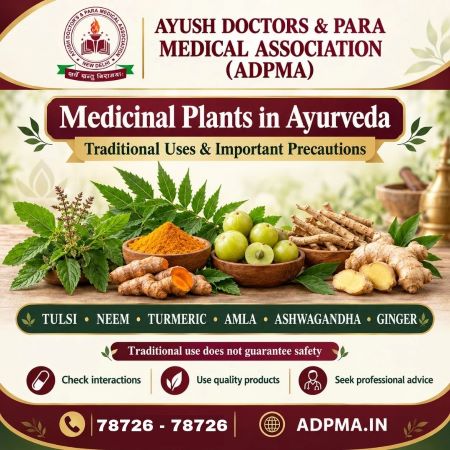
Medicinal Plants in Ayurveda: Traditional Uses and Important Precautions
Published by: AYUSH Doctors & Para Medical Association (ADPMA)
Ayurveda, one of India's traditional systems of healthcare, has a long history of using plants and plant-based preparations as part of health and wellness practices. Medicinal plants such as Tulsi, Neem, Turmeric, Amla and Ashwagandha are widely known in traditional Indian healthcare.
These plants are valued for their traditional uses, natural compounds and cultural significance. However, natural does not automatically mean safe, and the benefits of a plant may vary depending on its preparation, dosage, quality and the individual using it.
In this article, we explore some commonly known medicinal plants in Ayurveda, their traditional uses and important precautions for responsible use.
1. What Are Medicinal Plants in Ayurveda?
Medicinal plants are plants or plant parts traditionally used for health-related purposes. Depending on the plant, different parts may be used, including leaves, roots, bark, flowers, fruits and seeds.
In Ayurveda, the selection and use of medicinal plants are traditionally considered in the context of an individual's health, constitution, diet, lifestyle and specific needs.
Today, medicinal plants are also studied for their chemical constituents, biological activity, safety and possible therapeutic applications. However, traditional use alone does not establish that a plant is effective for every condition or suitable for everyone.
2. Common Medicinal Plants and Their Traditional Uses
A. Tulsi (Holy Basil)
Scientific name: Ocimum tenuiflorum (also known as Ocimum sanctum)
Tulsi is a familiar plant in Indian households and holds an important place in traditional Indian wellness practices. Its leaves are commonly used in traditional preparations and herbal beverages.
Traditional uses:
- Used in traditional practices for general wellness.
- Commonly included in herbal beverages.
- Traditionally associated with respiratory and seasonal wellness practices.
Important precautions:
Medicinal use of Tulsi should not be assumed to prevent or cure infections. People taking regular medicines, particularly those affecting blood glucose or blood clotting, should consult a qualified healthcare professional before using concentrated Tulsi preparations.
B. Neem
Scientific name: Azadirachta indica
Neem is widely recognised in traditional Indian practices. Its leaves, bark, seeds and oil have been used in different traditional applications.
Traditional uses:
- Used in traditional skin-care practices.
- Neem-based preparations are used in some personal-care products.
- Studied for various biological properties in laboratory research.
Important precautions:
Neem oil should not be swallowed. Ingestion can cause serious poisoning, particularly in children. Neem products may also cause irritation or other adverse effects. Avoid using concentrated preparations without appropriate professional guidance, and do not use neem as a substitute for prescribed treatment.
C. Turmeric (Haldi)
Scientific name: Curcuma longa
Turmeric is a common culinary spice and an important ingredient in many traditional Indian preparations. Curcumin is one of its best-known chemical constituents.
Traditional uses:
- Used in food and traditional dietary practices.
- Applied in certain traditional skin-care preparations.
- Studied for its anti-inflammatory and antioxidant properties.
Important precautions:
Using turmeric as a food ingredient is different from taking concentrated curcumin supplements. High-dose supplements may cause gastrointestinal problems and can interact with medicines. Some enhanced-absorption formulations have also been associated with liver injury. People with gallbladder problems or those taking regular medicines should seek professional advice before using concentrated supplements.
D. Amla (Indian Gooseberry)
Scientific name: Phyllanthus emblica (also known as Emblica officinalis)
Amla is a fruit used in traditional Indian diets and Ayurvedic formulations. It is valued for its nutritional content, including vitamin C, although levels can vary with processing and storage.
Traditional uses:
- Included in traditional dietary and wellness practices.
- Used in various Ayurvedic formulations.
- Commonly included in preparations intended to support general nutrition.
Important precautions:
Amla supplements may not be appropriate for everyone. People taking medicines for diabetes or blood clotting should consult their healthcare professional before using concentrated preparations. Dietary use should not be confused with evidence that a supplement can treat a specific disease.
E. Ashwagandha
Scientific name: Withania somnifera
Ashwagandha is a plant used in Ayurveda and is often described in traditional practice as a Rasayana herb. Modern research has examined some preparations for stress and sleep-related outcomes.
Traditional uses:
- Traditionally used in formulations intended to support general vitality.
- Commonly associated with stress-management and wellness practices.
- Studied for possible effects on stress and sleep, although findings depend on the preparation and study.
Important precautions:
Ashwagandha may cause drowsiness, stomach upset, diarrhoea or vomiting. Rare cases of liver injury have been reported. It should be avoided during pregnancy and is not recommended during breastfeeding because of insufficient safety information.
People with thyroid or autoimmune disorders, those preparing for surgery, and those taking medicines for diabetes, blood pressure, thyroid conditions or immune suppression should seek medical advice before use.
Evidence for one particular extract should not automatically be applied to all Ashwagandha products.
F. Ginger (Adrak)
Scientific name: Zingiber officinale
Ginger is widely used as a culinary ingredient and in traditional health practices. It is also studied for certain digestive symptoms and nausea.
Traditional uses:
- Used in traditional dietary practices for digestive comfort.
- Commonly included in herbal beverages and food preparations.
- Studied for possible benefits in some forms of nausea.
Important precautions:
Large amounts or concentrated supplements may cause heartburn, abdominal discomfort or diarrhoea. People taking anticoagulant or antiplatelet medicines, or those with relevant medical conditions, should ask a healthcare professional before using concentrated ginger supplements.
3. Traditional Uses Versus Scientific Evidence
Understanding the difference between traditional use and scientifically demonstrated effects is essential for responsible health education.
|
Medicinal plant |
Common traditional use |
Important consideration |
|
Tulsi |
General wellness and herbal beverages |
Evidence and safety depend on the preparation |
|
Neem |
Traditional skin-care practices |
Neem oil ingestion can be dangerous |
|
Turmeric |
Dietary and traditional wellness use |
Concentrated supplements may interact with medicines |
|
Amla |
Traditional dietary and Ayurvedic formulations |
Supplements may have different effects from food |
|
Ashwagandha |
Traditional vitality and wellness practices |
Potential interactions and specific safety concerns |
|
Ginger |
Dietary use and digestive comfort |
Concentrated supplements may cause side effects |
The scientific evidence is not equally strong for all plants or uses. Some preparations have been studied in human trials, while others are supported mainly by traditional use or preliminary laboratory research. The quality, size and design of studies must be considered before drawing conclusions.
4. Important Precautions Before Using Medicinal Plants
Medicinal plants should be used responsibly. The following precautions are important for the general public.
1. Consult a Qualified Healthcare Professional
Before using a medicinal plant to manage a health condition, seek advice from an appropriately qualified healthcare professional. Do not self-medicate based on social media posts, advertisements or another person's experience.
2. Inform Your Doctor About All Medicines and Supplements
Herbal products may interact with prescription medicines, over-the-counter medicines and other supplements. Tell your treating healthcare professional about every product you use.
3. Take Special Care During Pregnancy and Breastfeeding
The safety of many medicinal plants and concentrated herbal preparations has not been adequately established during pregnancy or breastfeeding. Avoid self-medication during these periods.
4. Choose Products With Reliable Quality Information
Check the product label, ingredients, manufacturer details, batch information, expiry date and applicable quality or regulatory information. Avoid products making unrealistic promises, such as guaranteed cures or immediate results.
5. Do Not Assume That More Is Better
The amount used in food may differ significantly from the dose present in a concentrated extract, capsule or traditional medicinal formulation. Do not increase a dose or combine multiple herbal products without professional advice.
6. Do Not Replace Essential Medical Treatment
Medicinal plants should not replace prescribed medicines or delay appropriate medical evaluation. Conditions such as diabetes, hypertension, infections and liver disease require suitable clinical assessment and management.
7. Be Careful With Homemade Preparations
Correct plant identification, contamination, preparation methods and concentration can affect safety. Avoid consuming unidentified plants or using concentrated homemade extracts without appropriate knowledge and guidance.
5. Can Medicinal Plants Cause Side Effects?
Yes. Medicinal plants and herbal products can cause adverse effects, just like other biologically active substances.
Possible concerns include:
- Allergic reactions or skin irritation.
- Digestive problems such as nausea, vomiting or diarrhoea.
- Interactions with prescription medicines.
- Liver or kidney injury from certain products or inappropriate use.
- Contamination, adulteration or undeclared ingredients in poor-quality products.
Some Ayurvedic preparations may also contain metals or minerals. Such products require appropriate quality controls and professional supervision. Consumers should not assume that every product marketed as herbal or Ayurvedic is free from potentially harmful substances.
If a person experiences a serious or unexpected reaction after using an herbal product, they should stop taking the suspected product and seek appropriate medical care. Severe breathing difficulty, swelling of the face or throat, or loss of consciousness requires emergency assistance.
6. The Role of Healthcare Professionals in Herbal Safety
Healthcare professionals play an important role in promoting informed and responsible use of medicinal plants. Their responsibilities may include:
- Educating patients about potential benefits, limitations and risks.
- Reviewing possible interactions between herbal products and prescribed medicines.
- Encouraging the use of products with reliable quality information.
- Recognising and reporting suspected adverse reactions through appropriate channels.
- Helping patients distinguish evidence-based information from unsupported health claims.
Healthcare education should respect traditional knowledge while also encouraging scientific evaluation, product quality, patient safety and responsible clinical decision-making.
7. Frequently Asked Questions (FAQs)
Q1. Are all medicinal plants safe because they are natural?
No. Natural products can contain biologically active substances that cause side effects, toxicity or interactions with medicines. Safety depends on the plant, preparation, amount used and individual health factors.
Q2. Can medicinal plants replace prescribed medicines?
No medicinal plant should automatically be considered a replacement for prescribed treatment. Any change to an existing treatment plan should be discussed with the treating healthcare professional.
Q3. Can medicinal plants be used by children?
Children may be more vulnerable to certain plant-related toxic effects, and appropriate doses and safety information may be unavailable. Do not give medicinal herbs or concentrated herbal supplements to children without professional advice.
Q4. Are herbal supplements and traditional Ayurvedic formulations the same?
Not necessarily. Products can differ in their ingredients, processing, formulation, quality standards and intended use. The product label and relevant regulatory requirements should be reviewed carefully.
Q5. Where can people find reliable information about medicinal plants?
People should consult qualified healthcare professionals and credible sources, including official health departments, the Ministry of AYUSH, recognised research institutions and evidence-based health information services.
Conclusion
Medicinal plants have an important place in India's traditional healthcare heritage. Tulsi, Neem, Turmeric, Amla, Ashwagandha and Ginger are familiar examples of plants used in traditional dietary and wellness practices.
However, responsible use requires more than knowledge of traditional applications. Product quality, preparation, dosage, possible interactions and the individual's health status must also be considered.
The key message is simple: respect traditional knowledge, evaluate health claims carefully and prioritise patient safety. Public awareness and professional guidance can help people make better-informed decisions about medicinal plants and herbal products.
About AYUSH Doctors & Para Medical Association (ADPMA)
AYUSH Doctors & Para Medical Association (ADPMA) supports healthcare awareness, professional education and the responsible exchange of knowledge related to healthcare and allied fields.
Contact Details
AYUSH Doctors & Para Medical Association (ADPMA)
Aman Nagar, Behind Green Land School, Near Jalandhar Bye Pass, Ludhiana – 141008, Punjab, India
Email: adpma2001@gmail.com
Website: www.adpma.in